
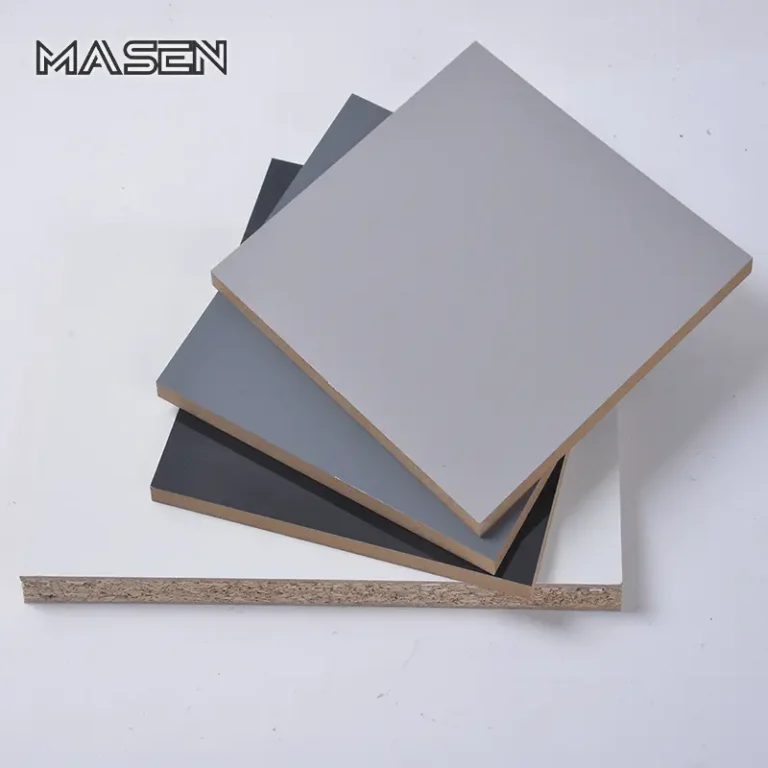
What Is PET Laminated Board?
PET laminated board is a decorative panel made by laminating a PET (Polyethylene Terephthalate) film onto a substrate such as MDF, particle board, or plywood. Thanks to its excellent appearance, durability, and environmental performance, PET boards have become one of the most popular materials for modern furniture manufacturing.
PET decorative panels are widely used for:
- Kitchen cabinets
- Wardrobe doors
- Bathroom cabinets
- TV units
- Office furniture
- Interior wall panels
Compared with traditional surface materials, PET offers a combination of premium aesthetics, environmental friendliness, and long-term durability.
The Evolution of Furniture Surface Materials
Over the past decades, furniture surface materials have evolved significantly:
PVC Film → Acrylic → PET
PET combines many advantages of previous generations:
- The high-end appearance of acrylic
- The processing convenience of PVC
- Better environmental performance
- Improved scratch resistance
- Enhanced anti-yellowing properties
As a result, PET has become a preferred choice for furniture manufacturers worldwide.
High Gloss PET vs Super Matte PET
PET decorative panels are generally divided into two categories: High Gloss PET and Super Matte PET.
High Gloss PET
High Gloss PET features a mirror-like surface that creates a bright and modern appearance.
Advantages:
- High gloss finish
- Excellent color depth
- Smooth surface texture
- Ideal for contemporary kitchen designs
- Easy to clean
Applications:
- Kitchen cabinet doors
- Modern wardrobes
- Display cabinets
- Commercial interiors
Super Matte PET
Super Matte PET, also known as Skin-Touch PET, offers a premium low-reflection surface with a soft-touch feel.
Advantages:
- Anti-fingerprint performance
- Better scratch resistance
- Luxurious appearance
- Soft-touch texture
- Higher surface hardness
Applications:
- High-end wardrobes
- Premium furniture
- Modern interior decoration
- Luxury residential projects
For furniture manufacturers targeting premium markets, Super Matte PET has become increasingly popular due to its elegant appearance and practical performance.
Why PET Boards Are Environmentally Friendly
Environmental protection is becoming increasingly important in furniture manufacturing.
PET film itself contains:
- No formaldehyde
- No heavy metals
- No plasticizers
High-quality PET panels can comply with international standards such as:
- CARB P2
- EPA TSCA Title VI
- EN 14322
- E0 Standard
- E1 Standard
This makes PET decorative panels suitable for residential, commercial, and export furniture applications.
Common Base Materials for PET Laminated Boards
The quality of a PET panel depends not only on the PET film itself but also on the substrate used underneath.
PET MDF Board
MDF is the most widely used substrate for PET lamination.
Advantages:
- Smooth and uniform surface
- Easy machining
- Excellent dimensional stability
- Cost-effective
Best for:
- Cabinet doors
- Wardrobe doors
- Decorative furniture panels
PET Particle Board
Particle board offers an economical solution for furniture production.
Advantages:
- Lower cost
- Good structural stability
- Suitable for mass production
Best for:
- Modular furniture
- Residential cabinets
- Cost-sensitive projects
PET Plywood
Plywood provides higher mechanical strength and moisture resistance.
Advantages:
- Superior strength
- Better screw-holding capability
- Improved moisture resistance
Best for:
- High-end furniture
- Humid environments
- Commercial projects
PET Film Thickness Options
PET films are available in various thicknesses depending on the application requirements.
Common options include:
- 0.20 mm (20 Silk)
- 0.35 mm (35 Silk)
- 0.50 mm (50 Silk)
- 1.00 mm PET Film
Among them, 1 mm PET film provides the highest durability and can achieve surface hardness up to 6H.
This makes it particularly suitable for:
- Interior doors
- Wardrobe doors
- High-traffic furniture surfaces
Typical door panel dimensions include:
- 920 × 2150 mm
- 920 × 2200 mm
These sizes are widely used in residential furniture and interior door manufacturing.
PET Laminated Board Manufacturing Process
The performance of a PET panel depends heavily on the production process.
Step 1: Substrate Preparation
Common substrates include:
- MDF
- Particle Board
- Plywood
The boards undergo sanding to achieve a uniform thickness and smooth surface.
The process typically includes:
- Coarse sanding
- Fine sanding
- Surface polishing
After sanding, dust removal is performed to eliminate wood particles and ensure a clean bonding surface.
Step 2: Melamine Paper Lamination
Before PET lamination, a melamine paper layer is applied to the board surface.
This additional layer provides several advantages:
- Improved bonding strength
- Better surface flatness
- Reduced bubbling risk
- Reduced edge lifting
- Reduced delamination risk
- Increased durability
The melamine layer creates a more stable surface for PET film adhesion and helps ensure long-term performance.
Step 3: PUR Glue Application
PUR (Polyurethane Reactive) adhesive is commonly used for PET lamination.
Benefits of PUR glue include:
- Strong bonding strength
- Excellent moisture resistance
- High heat resistance
- Long-term durability
Step 4: PET Film Lamination
The PET film is laminated onto the prepared board under controlled pressure and temperature conditions.
This step determines:
- Surface appearance
- Adhesion quality
- Long-term stability
Step 5: Quality Inspection
Each finished panel undergoes quality inspection to verify:
- Surface smoothness
- Gloss consistency
- Bonding strength
- Scratch resistance
- Dimensional accuracy
Our Advantages in PET Lamination
The quality of a PET decorative panel depends on more than just the PET film itself.
Our production process focuses on achieving stronger bonding and improved long-term performance.
Key advantages include:
- Enhanced adhesion through melamine underlayer technology
- Reduced risk of bubbling and delamination
- Stable surface quality
- Strong tear resistance
- Excellent durability
- Suitable for furniture manufacturing applications
By combining quality substrates, melamine surface treatment, PUR adhesive technology, and strict quality control, we ensure reliable PET laminated panels for furniture manufacturers worldwide.
Conclusion
PET laminated boards have become one of the most important decorative materials in the furniture industry. Whether you choose High Gloss PET for a bright modern appearance or Super Matte PET for a premium anti-fingerprint finish, PET panels offer excellent aesthetics, durability, and environmental performance.
By selecting the right substrate, film thickness, and manufacturing process, furniture manufacturers can achieve superior product quality and long-term customer satisfaction.