
Why More Furniture Manufacturers Are Switching to 7×9 FT and 7×10 FT Large Size MDF Boards
In the furniture manufacturing industry, panel materials account for a significant portion of production costs. As labor and raw material costs continue to rise, manufacturers are constantly looking for ways to improve material utilization, reduce waste, and increase production efficiency.
This is one of the main reasons why large-size MDF and particle boards, such as 7×9 FT and 7×10 FT panels, are becoming increasingly popular. Compared with traditional 4×8 FT boards, oversized panels offer higher material yield, better production efficiency, and greater flexibility for modern furniture design.
1. Door Manufacturing: Material Utilization Can Exceed 90%
Let’s take interior door production as an example.
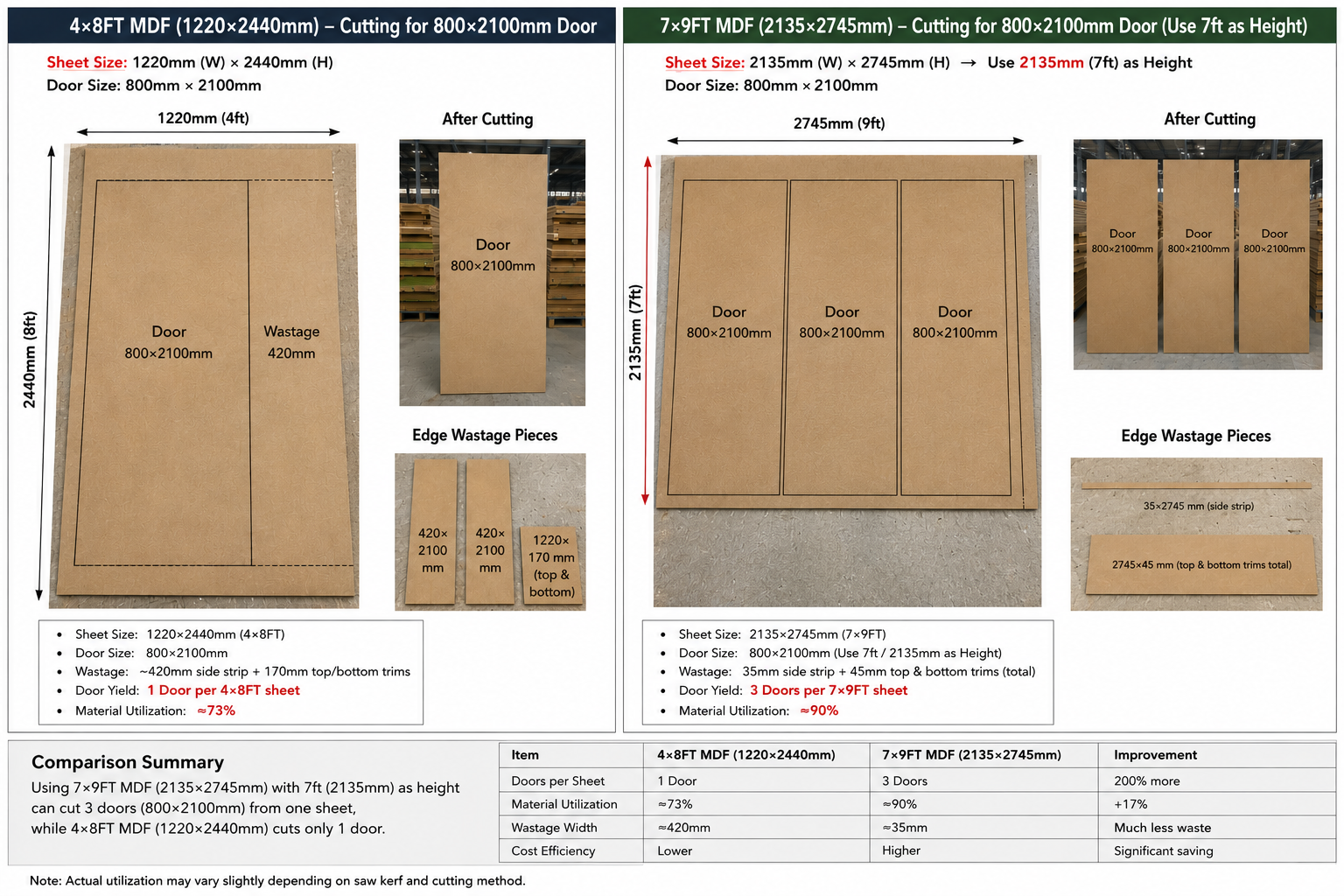
A standard 4×8 FT (1220 x 2440 mm) MDF board can typically produce only one complete door panel measuring 900 x 2100 mm. The remaining material is often difficult to utilize efficiently, resulting in considerable waste.
A 7×9 FT (2135 x 2745 mm) MDF board provides a completely different result.
After accounting for saw kerf during production, one 7×9 FT board can produce:
- Two bedroom doors with a width of 900 mm
- One bedroom door with a width of 800 mm
Or:
- Three bedroom doors with a width of 800 mm
Even after cutting, a remaining strip measuring approximately 343 x 2135 mm is left. Because its length closely matches the height of a standard door frame, this leftover material can be further processed into door jambs, side casings, or frame components.
As a result, the overall material utilization rate can exceed 90%, significantly reducing production waste and lowering material costs. For door manufacturers producing thousands of units each year, the savings can be substantial.
2. Break Through Size Limitations and Produce Large Tabletops with Ease
Demand for large furniture components continues to grow in both residential and commercial markets. Examples include:
- Conference tables
- Dining tables
- Workstations
- Training tables
- Reception desks
When using traditional 4×8 FT MDF boards, manufacturers often face size limitations and must join multiple panels together to achieve the required dimensions. This creates several challenges:
- Additional processing steps
- Increased labor costs
- Visible joints and seams
- Reduced visual appeal
- Potential structural weaknesses
With 7×9 FT and 7×10 FT MDF boards, many large tabletops can be produced from a single panel without any splicing. The result is a cleaner appearance, stronger structure, and more efficient production process.
3. Nesting Optimization Creates a Significant Increase in Material Yield
For panel furniture manufacturers, the true cost of a board is determined not only by its purchase price but also by how efficiently it can be utilized. After cutting large components from standard boards, factories often end up with irregular offcuts that are difficult to reuse.
Large-size MDF boards provide nesting software with much greater flexibility. Manufacturers can adopt a “large parts combined with small parts” nesting strategy. For example, after cutting several large tabletops, the remaining spaces can simultaneously accommodate:
- Side panels
- Back panels
- Drawer bottoms
- Reinforcement strips
- Shelves and small components
This approach dramatically improves material yield while reducing waste generation. Even a small increase in utilization can result in significant annual savings for high-volume furniture manufacturers.
4. Higher Production Efficiency
Production efficiency directly impacts manufacturing costs and competitiveness. When processing standard-size panels, factories often need to perform:
- Multiple loading operations
- Repeated positioning
- Additional cutting cycles
- More material handling
Each extra step consumes labor, machine time, and production resources. Large-size boards allow manufacturers to produce more components from a single loading cycle.
In simple terms: Standard Boards require multiple operations and processing cycles, while Large-Size Boards achieve multiple finished components from a single loading cycle. The efficiency advantages become even more significant for factories using CNC routers, beam saws, and automated furniture production lines.
5. The Ideal Solution for Custom and Irregular Furniture Designs
The growing demand for customized furniture has increased the popularity of unique and non-standard designs. Examples include:
- Curved office desks
- Irregular conference tables
- Custom reception counters
- Special-shaped tabletops
These products require larger processing areas and greater design flexibility. Traditional 4×8 FT boards often limit layout options and increase material waste. In contrast, 7×9 FT and 7×10 FT boards provide designers and manufacturers with significantly more freedom when creating custom furniture. Even complex shapes can be nested more efficiently, improving both material utilization and production flexibility.
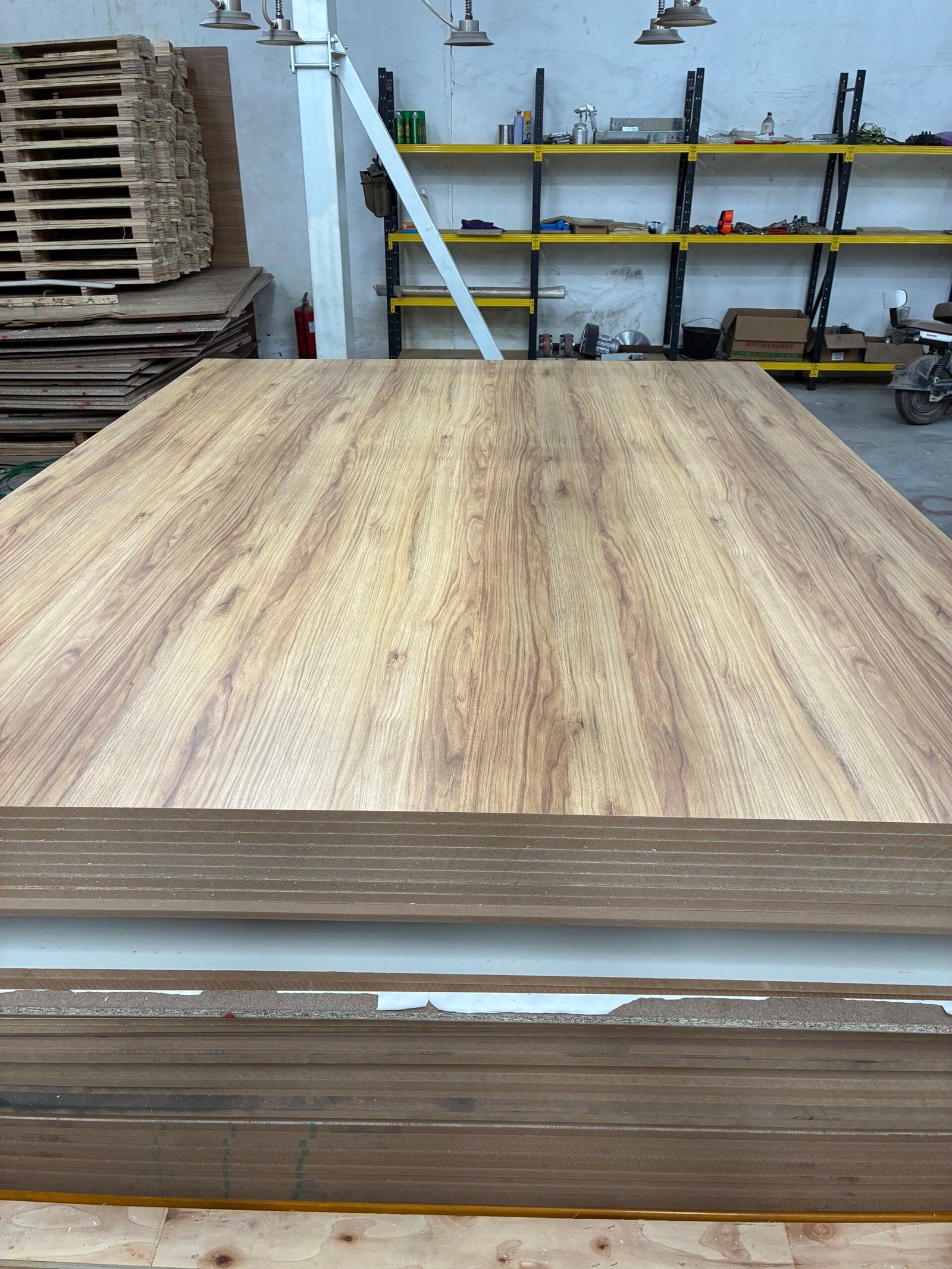
6. Better Consistency in Decorative Surfaces and Wood Grain Patterns
For melamine-faced MDF, synchronized wood grain panels, and decorative boards, visual consistency is extremely important. When multiple standard-size boards must be joined together, manufacturers often encounter:
- Grain pattern mismatches
- Visible color variations
- Inconsistent surface appearance
Large-size boards allow more furniture components to be cut from the same panel. This results in:
- Better grain continuity
- More consistent color matching
- Higher-end appearance
- Improved customer satisfaction
These advantages are particularly valuable in premium wardrobes, hotel furniture, and commercial interior projects.
Conclusion
For modern furniture manufacturers, large-size MDF boards represent more than just larger dimensions – they offer a smarter and more efficient way to produce furniture.
Compared with traditional 4×8 FT boards, 7×9 FT and 7×10 FT MDF boards provide:
- Higher material utilization
- Less waste and fewer joints
- Increased production efficiency
- Better decorative consistency
- Greater design flexibility
As automation and customized furniture manufacturing continue to expand, large-size MDF boards are becoming an increasingly important solution for manufacturers seeking higher productivity and lower production costs.
Ready to Start Your Project?
Request free samples today and experience the MASEN difference. Our team is ready to help you find the perfect board solution for your business.